
Timed-Release Melatonin Explained: Dosage, Duration & Who It's Best For
31 Aug 2026
Key Takeaways
- Regular melatonin gives you one quick burst that fades fast. Great for falling asleep, useless for staying asleep.
- Timed-release spreads that dose out over 6-8 hours, so it's still working during the 2am-5am stretch when most people jolt awake.
- Bi-layer tablets do both jobs at once: a fast hit to help you drift off, then a slow-release layer to keep you asleep.
- The fix depends on where your night breaks down. Trouble falling asleep, waking mid-night, and waking too early each call for a different format.
- Start small (2-3mg is plenty for most people) and take it 30-60 minutes before bed. More isn't better, it just means more grogginess.
- Side effects are usually a dosing problem, not a melatonin problem. Grogginess, headaches, or nausea often disappear once you scale back or take it earlier.
- Pregnant or breastfeeding women, people with autoimmune conditions, and anyone on blood thinners or certain meds should check with a doctor first.
- If melatonin isn't fixing your sleep after a few weeks, that's worth flagging to a doctor. It could be something else going on, like sleep apnea or anxiety.
Falling asleep isn't your problem. You know that already. Lights off, head on the pillow, and you're gone within twenty minutes, easy. Then somewhere around 3am, your eyes pop open, and you're lying there doing that annoying math again, like how much sleep is left if you drift off right now versus in ten more minutes?
Sound familiar? There's an actual biological reason this happens more as you get older. The pineal gland produces less melatonin with age, and whatever it does release tends to taper off faster overnight. Which lines up, almost too perfectly, with when most people jolt awake around 2am or 3am and can't seem to settle back down.
Here's the thing, though. Most melatonin advice out there is written for a different problem, people who can't fall asleep in the first place. If you wake up mid-night or open your eyes at half past four with zero chance of drifting off again, the type of melatonin you take matters more than how much you take. So, let's get into what timed release melatonin does inside your body, how long it sticks around, and who it tends to work best for.
Table of Contents
- What Timed Release Melatonin Actually Means
- What the Research Shows About Extended Release Melatonin
- Fast Acting or Timed Release, Which One Fits Your Sleep Problem
- Dosage and Timing for Extended Release Melatonin
- Possible Side Effects of Slow Release Melatonin
- Who It’s Best For
- Make Timed Release Melatonin Part of a Real Sleep Routine
- FAQs
What Timed Release Melatonin Actually Means
Regular melatonin tablets are immediate release, which means the whole dose hits your bloodstream at once. The tablet dissolves, your levels spike within thirty to sixty minutes, and then it's gone again in a few hours. This is fine if your only issue is taking forever to doze off.
Timed release melatonin works differently. The tablet gets coated or layered so the melatonin trickles out gradually instead of all at once.
How Bi-Layer Tablets Work
A lot of these tablets rely on a bi-layer design, basically two tablets stacked into one. The top layer releases a small hit of melatonin right away, enough to help you drift off. The bottom layer dissolves much more slowly, doling out melatonin over the next six to eight hours. Other brands skip the layers and use a slow-dissolving matrix instead. Either way, the goal is identical, keep melatonin circulating in your blood for longer instead of letting it vanish after an hour.
What the Research Shows About Extended Release Melatonin

A 2023 crossover study in the Journal of Dietary Supplements tested this. Eighteen healthy adults took a 4mg dose of extended release melatonin one night, then a 4mg dose of immediate release melatonin on a different night, and researchers tracked their blood melatonin levels for ten hours straight.
The immediate release dose peaked fast, about thirty six minutes in, then cleared out almost as quickly, with a half-life under an hour. That's markedly faster than the one to two hours the NHS cites for melatonin to start working. The extended release version took its time instead, peaking around ninety three minutes at a lower concentration overall, but it stayed above 300 pg/mL for roughly six hours before finally tapering off around the nine hour mark.
Hence, immediate release gives your body one strong burst that fades fast, like a match. Extended release trades that spike for a longer, steadier burn, one that's still active well into the second half of the night, right when most middle of the night waking actually happens.
Fast Acting or Timed Release, Which One Fits Your Sleep Problem
Not every sleep problem calls for the same fix. It depends on where, exactly, your night falls apart.
Toss and turn for an hour before finally drifting off, but sleep fine after that? Fast dissolving or liquid melatonin is probably your better bet, since it clears your system before morning anyway. But if you fall asleep fine and then wake at 1am, 3am, or 5am unable to get back under, that's not a falling asleep problem. That's a supply problem, and matching the release type to the actual issue is what separates timed-release and fast-acting melatonin.
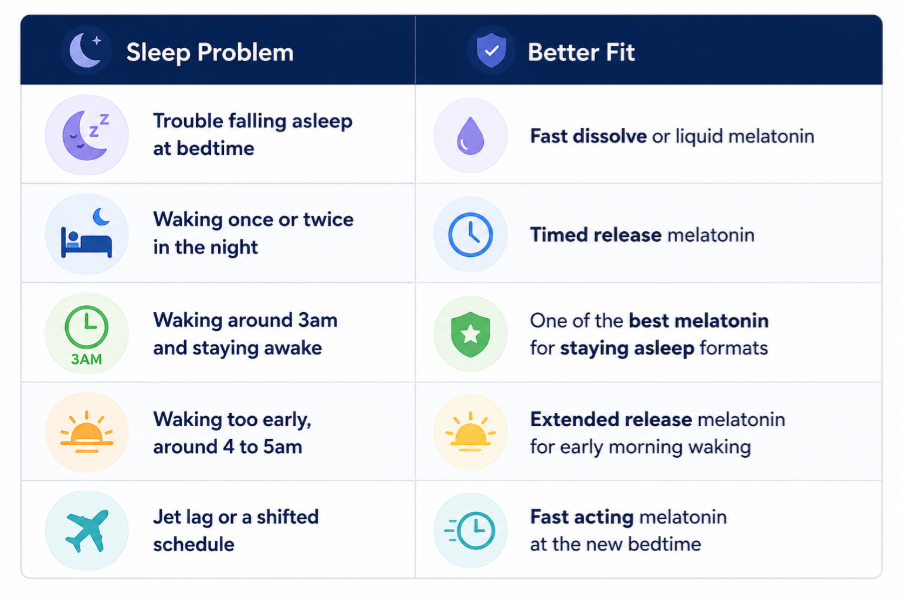
Melatonin for waking up at night and melatonin for early morning waking are really pointing at the same root cause, your natural melatonin dropping off before your body is actually done needing it. Stretch out the release window, and that gap closes.
Dosage and Timing for Extended Release Melatonin

Extended release melatonin ranges anywhere from 3mg to 5mg, but bigger doses don't automatically work better, since melatonin receptors saturate pretty quickly, past a certain point, you're only adding side effect risk, not benefit.
A sensible starting point for most adults sits around 2mg to 3mg, taken thirty to sixty minutes before bed. Prolonged release products like Circadin need more lead time, usually one to two hours ahead, since the slower onset needs a head start.
Consistency matters more than hitting some exact number. Taking it at the same time each night reinforces your circadian rhythm, rather than patching over one rough night. The best time to take melatonin depends on your usual bedtime and whether you have jet lag or work shifts.
Possible Side Effects of Slow Release Melatonin

Slow release melatonin is generally easy on the body, but side effects do show up more often when the dose runs too high or when you take it too close to whenever you actually need to be up and alert.
- Next-day grogginess, the most common issue
- Mild headache
- Dizziness
- Occasional nausea
Who It's Best For
Timed release melatonin is not the right fit for every sleeper. It helps with some sleep problems and does little for others. Here's who it works for, and who's better off skipping it.
- People who wake at 1am, 3am, or 5am and cannot fall back asleep get the most out of it, since timed release melatonin stays active through the stretch of night when regular melatonin has already worn off.
- Older adults tend to benefit more than younger sleepers, because natural melatonin production declines with age.
- Shift workers and frequent travelers also do well with it, since a shifting sleep schedule needs steady coverage rather than one quick burst.
- People whose only issue is falling asleep should skip it. A fast dissolving or liquid format works faster and clears out of the system before morning.
- Pregnant and breastfeeding women, and anyone managing an autoimmune condition, should check with a doctor before starting.
- Anyone on blood thinners or other medications should talk to a doctor first as well.
Sleep problems that persist after a few weeks of consistent use are worth raising with a doctor, since they could point to something else, like sleep apnea or anxiety.
Make Timed Release Melatonin Part of a Real Sleep Routine
If 3am wake ups are the pattern grinding you down, more of the same probably isn't the fix. What helps is switching to a format built to last through the stretch of night immediate release melatonin can't reach.
Ready to try one? Shop Vitasunn's timed release melatonin options right alongside the fast acting formats, and pick whichever one actually matches your problem, falling asleep or staying asleep.
FAQs
What is timed-release (extended-release) melatonin?
It's melatonin made to release its dose gradually over several hours instead of all at once, which keeps your blood levels raised longer through the night.
How is timed-release melatonin different from regular / fast-acting melatonin?
Fast-acting melatonin creates one strong peak within about thirty to sixty minutes, then clears out. Timed release spreads that same dose across six to eight hours instead, which suits people who wake up partway through the night rather than people who can't fall asleep to begin with.
Does timed-release melatonin help you stay asleep through the night?
For a lot of people, yes. Since it keeps blood levels raised for longer, timed release melatonin often outperforms immediate release melatonin for staying asleep, especially when the real problem is waking at 2am or 3am rather than taking forever to nod off.
How long does timed-release melatonin last in your system?
Somewhere around six to eight hours, compared with four to five hours for immediate release melatonin. The exact duration really depends on your dose, your metabolism, and which formulation you're using.
Who should choose timed-release over immediate-release melatonin?
People who fall asleep without much trouble but wake up mid-night or too early in the morning. Immediate release tends to suit people whose main struggle is taking forever to fall asleep at bedtime in the first place.
What's the best dosage for timed-release melatonin?
Most adults do fine starting between 1mg and 3mg, since higher doses raise your risk of next day grogginess without actually improving results. Prescription Circadin sticks to a fixed 2mg dose. Start low, and only adjust if you genuinely need to.
Can extended release melatonin help with middle-of-the-night or early-morning waking?
Yes. Extended release melatonin for early morning waking and for middle of the night waking is really addressing the same gap, your natural melatonin dropping off too early, by keeping supplemental levels raised further into the morning hours.
When should I take timed-release melatonin before bed?
Most over-the-counter products get taken thirty to sixty minutes before bed. Prescription Circadin needs more lead time, one to two hours before bedtime and after food, since its slower onset takes a while to kick in.
Are there side effects specific to extended-release melatonin?
Mostly next day grogginess, since the supplement is still active later into the morning than you might expect. Headache, dizziness, and occasional nausea show up sometimes too, usually when the dose is higher than it needs to be.
Can I take timed-release and fast-acting melatonin together?
Not usually necessary, and it can push your total dose higher than intended, which raises your grogginess risk. A single timed release or bi-layer product generally does the job better than stacking two separate supplements. Check with a doctor first if you're unsure.