
Does Melatonin Help With Weight Loss? What The Research Shows
7 Aug 2026
Key Takeaways
- There is insufficient evidence that melatonin is a reliable cause of weight loss in humans.
- Around fifty percent of the clinical studies examined (11 out of 23) have shown a slight positive effect in doses of up to 8mg per day.
- Animal studies display more positive results regarding fat metabolism compared to human ones.
- Lack of sleep contributes to weight gain, and this could be the indirect reason why melatonin affects weight.
- It is best used in addition to sleep hygiene, proper diet, and physical activity, and not as an alternative.
You have reduced your calorie intake and visited the gym, but there was no change on the weighing scales. What's more, you have realized one thing: the poor-sleep nights coincide with those when you crave sweets and skip your workouts. Hence, the suggestion about the potential of melatonin to reduce body weight is pretty tempting to you.
The possibility of getting two benefits from using one product seems attractive indeed, considering how melatonin controls the rhythm of your body.
But is it possible that melatonin can affect fat deposits and metabolism?
Can it help you reduce your body weight?
This blog gives you an opportunity to find out whether the effect of melatonin on body weight exists or it is just another supplement myth.
Learning about melatonin weight loss facts requires you to consider the scientific proof seriously, because the issue is much more complex than media reports suggest.
Table of Contents
- The Claim
- How Melatonin May Affect Metabolism
- Human Evidence vs. Animal Studies
- Does It Cause Weight Gain?
- The Sleep-Weight Connection
- Realistic Expectations & Dose
- Safety
- Verdict In A Nutshell
- FAQs
The Claim
The notion being spread across the Internet is straightforward: ingest melatonin, sleep well, and metabolize more fat. Other sources are even bolder, stating that melatonin actually stimulates fat metabolism in the body.
This information should fall into a grey zone.
Does melatonin help you lose weight? Not necessarily. However, there are specific mechanisms of action through which melatonin weight loss affects metabolism, and it would be reasonable to learn about these before completely dismissing the notion.
The misunderstanding here lies in the way the term is utilized by supplement companies, using scientific notions like thermogenesis, insulin sensitivity, brown fat, etc., without realizing that the majority of research was conducted in animals, not humans. That is precisely the gap this write-up is going to bridge.
How Melatonin May Affect Metabolism

Several mechanisms come up through research as well.
For starters, there is melatonin brown fat thermogenesis, where melatonin seems to have an impact on the process whereby brown and beige fat tissues consume energy to generate heat instead of storing it.
In animal experiments, melatonin can cause the browning of white fat cells, potentially leading to increased metabolism of calories. There are studies of melatonin and insulin sensitivity, and there have been indications that melatonin might help with blood sugar and insulin sensitivity, which are associated with fat storage.
It has also been observed by researchers that there are correlations between the use of melatonin and the expression of genes that control circadian rhythm, including genes controlling inflammation and metabolism.
To better understand melatonin's fundamental role in the body, it's important to first understand what melatonin is and how it works.
Human Evidence vs. Animal Studies
It is here where the use of the evidence-based approach becomes crucial. Promising results are regularly reported in animal studies; however, human studies tell a more complicated story: 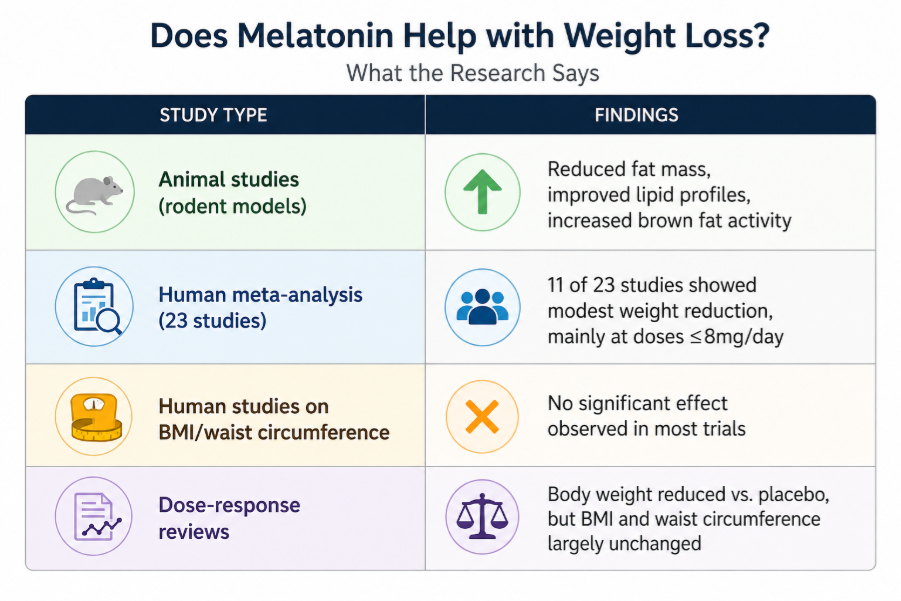
Specifically, in 2023, researchers published a dose-response meta-analysis showing that the addition of melatonin led to a decrease in body weight relative to placebo in doses up to 8mg per day. However, no statistically significant effect on BMI and waist circumference was detected in this study. The findings further confirm that the effect of taking melatonin is dose-dependent and relatively small.
Melatonin fat loss studies illustrate once again that although there are reasons to believe that the metabolic role of this hormone is well-established, it does not mean that it can serve as an effective fat-loss strategy on its own. Moreover, the difference in results between rodent and human studies explains the necessity to carefully translate the findings obtained in laboratory conditions into practical guidelines regarding melatonin supplements.
Does It Cause Weight Gain?
On the other hand, there are those who wonder about the possibility of melatonin causing weight gain. Research currently does not indicate that melatonin causes weight gain in most healthy individuals.
It is important to note, however, that indirect factors need to be considered here. Poor sleep is associated with weight gain. Thus, when taking melatonin for sleep improvement but still gaining weight, one should consider that the "weight gain" could have something to do with other aspects of one's lifestyle as noted by Medical News Today.
The Sleep-Weight Connection
This is where melatonin can actually make an impact. Sleep and weight-loss go hand-in-hand since a lack of sleep negatively affects the hunger hormones, such as ghrelin and leptin, making you eat more food with calories.
Improving sleep with the help of melatonin could therefore lead to better eating habits and energy levels, even without burning fat. Reading more on the topic will help you to find out how exactly poor sleep affects your metabolism and weight.
In other words, melatonin metabolic health benefits are due to sleep improvements rather than any fat-burning capabilities.
Realistic Expectations & Dose

If you're thinking about melatonin from a metabolic point of view, remember that the vast majority of successful studies on humans have involved no more than 8mg of melatonin taken daily, and the results weren't spectacular but rather moderate. Melatonin needs to be regarded as a supplement that might work for you in combination with other measures but certainly not a stand-alone weight loss remedy.
Nutrition, exercise, and sleep are the main factors in making any change to melatonin belly fat or any other body composition issue.
Stress control is another important factor, as high cortisol levels prevent good sleep and proper fat storage. The use of supplements such as Ashwagandha Extract 500 mg, 60 vegetarian capsules is common in order to maintain good hormonal balance when it comes to stress levels.

Those preferring chewing to swallowing could use Ashwagandha Complete Gummies made by Natrol with ashwagandha extract, selenium, and vitamin B12 in order to manage stress and improve their mood.

Safety
Melatonin is regarded as being generally safe to use for a short duration in healthy adults; however, there is always a possibility of risks when it is used with unrealistic expectations. The reliance on it to act as a means of losing weight rather than sleeping will cause one to be disappointed.
Diabetics, people with hormonal problems, and people on medication should check with their doctor before including it in their weight loss program, as there may be some side effects depending on how each person reacts to it.
Verdict In A Nutshell
Melatonin doesn't seem like a weight loss aid at all, but it’s not completely out of the picture. There is the most solid indication of an indirect relationship between the two.
In other words, healthy metabolism is promoted by quality sleep, and that's where the benefits of melatonin are found. Think of it as just another component of your routine instead of a magic pill.
To start your melatonin journey, you can browse the latest and best products for sleep management and weight loss from Vitasunn here.
FAQs
Does Melatonin Help You Lose Weight?
Not really. The scientific evidence is mixed but suggests possible weight loss benefits only at low doses up to 8 mg daily.
Can Melatonin Make You Gain Weight?
According to the current scientific data, melatonin does not seem to cause weight gain in healthy adults.
How does melatonin affect metabolism and fat?
Melatonin might affect the activity of brown fat cells and insulin sensitivity, but with less evidence in humans than in animals.
What Does Scientific Research Say about Melatonin and Weight Loss?
A meta-analysis of the existing studies reported modest weight loss effects in 11 out of 23 studies and no effects on BMI and waist circumference.
Is There Any Connection Between Poor Sleep and Weight Gain?
Poor sleep influences hormones that control our hunger, so there are more chances to gain weight because of increased appetite.
How Much Melatonin Should I Take to Support My Metabolism?
Most of the studies demonstrating modest beneficial effects on metabolism took 8 mg daily.
Can melatonin boost insulin sensitivity?
Though there have been some studies linking these two, the findings have been conflicting and inconclusive in humans.
Can melatonin reduce belly fat?
There has been no concrete evidence showing that melatonin can help reduce belly fat in humans.
Can melatonin replace diet and exercise?
Not really. Melatonin is just one of the factors to be taken into consideration when it comes to weight reduction.
Can there be adverse effects to taking melatonin for weight loss?
The primary side effect would be depending too much on melatonin, which will take attention away from other proven ways of reducing weight.