
The Complete Melatonin Supplement Guide: Types, Strengths & How To Choose For Better Sleep
10 Sep 2026
Key Takeaways
- Format and strength are more important than the number on the label. A 1mg gummy and a 10mg tablet are built for different problems, not different tastes.
- Most adults do best starting low, 0.5mg to 1mg, taken 30 to 60 minutes before bed rather than at the moment they climb under the covers.
- Higher melatonin dosage doesn't mean faster or deeper sleep; past a certain point, it mostly raises the odds of morning grogginess.
- Side effects tend to be mild, such as headache, nausea, dizziness, or vivid dreams, and serious reactions are rare.
- Pregnant or breastfeeding women, anyone on blood thinners or immunosuppressants, and children should check with a doctor first.
You've probably tried melatonin once, grabbed whatever was on the shelf, and it either worked a little or did nothing at all. That's rarely about the hormone itself, it's usually about the mismatch between what you took and what you needed.
Melatonin comes as tablets, gummies, and liquid, in doses running from 0.5mg up to 10mg, and reaching for the wrong one is the most common reason people give up on it.
Melatonin supplements don't sedate you, they tell your body that night has arrived and it’s time to sleep. Because of that, the format and strength you pick decide whether you get a quick nudge to fall asleep or a slow, steady one to stay asleep.
Table of Contents
- How Melatonin Works and When a Supplement Actually Helps
- Melatonin Tablets, Gummies, and Liquid Form
- What the Different Strengths Are Used For
- When and How to Take Your Melatonin Dose
- Melatonin Side Effects and Whether It's Habit Forming
- Who Should Speak to a Doctor Before Taking Melatonin
- How to Choose the Right Melatonin Supplement for You
- Better Sleep Starts With the Right Dose and Timing
- Frequently Asked Questions
How Melatonin Works and When a Supplement Actually Helps

Melatonin levels start climbing once it gets dark outside. They peak somewhere around the middle of the night, then drop off toward morning, and that whole rise and fall keeps your circadian rhythm, your internal 24-hour clock, running on time. When you scroll on your phone in bed, you're directly fighting that rise, because screen light blunts it, which is why your bedtime keeps slipping later than planned.
Melatonin is one of the most studied sleep supplements you can buy without a prescription. Unlike many other natural sleep aids on the same shelf, melatonin's primary function is to regulate timing rather than induce sedation. So, melatonin for sleep tends to help in specific situations rather than fixing every kind of rough night.
Situations Where a Supplement Genuinely Helps
- Jet lag, which happens after you've crossed several time zones and your body clock hasn't caught up yet.
- Shift work, when your hours sit opposite the usual day and night pattern.
- Delayed sleep phase, where you naturally fall asleep and wake up hours later than you'd like.
- Occasional sleeplessness, with a handful of rough nights rather than ongoing insomnia.
It's worth noting that a Cochrane review of melatonin for jet lag found it eases symptoms in travelers crossing five or more time zones, one of the more solid findings in this whole area of sleep research.
Melatonin Tablets, Gummies, and Liquid Form
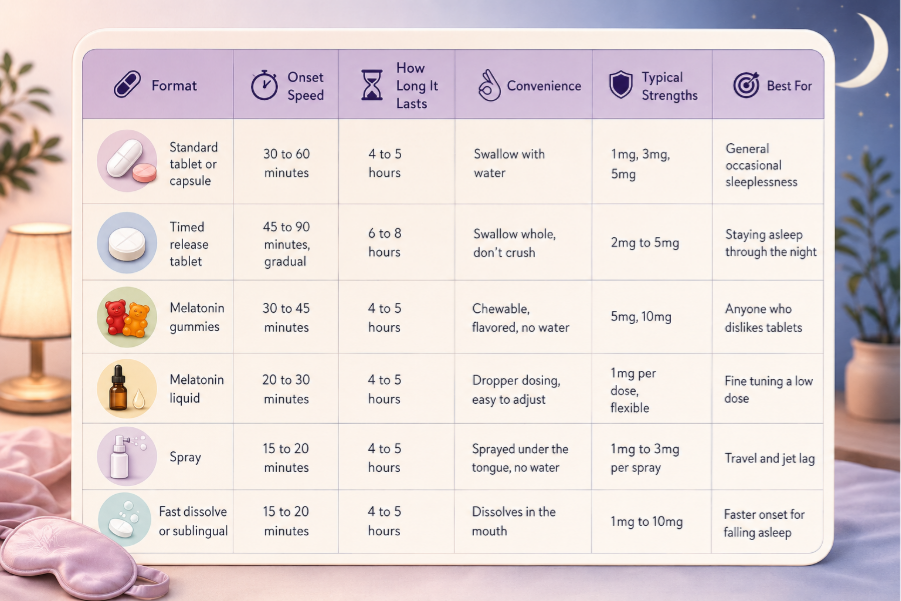
Same hormone, different delivery. That's really the whole story with format, and it changes how fast melatonin starts working and how long it sticks around.
The Fastest and Slowest Formats
- Fastest, spray or fast dissolve melatonin taken sublingually, absorbed through the mouth.
- Slowest but longest lasting, timed-release tablets, built to release gradually overnight.
- Middle ground, standard tablets, Natrol's 10mg gummies and liquid, digested at a similar pace.
What the Different Strengths Are Used For

Many people assume that a higher melatonin dosage means deeper sleep. Research doesn't really back that up, though. Push far past what your body naturally makes, and you're not getting faster or better results, just a higher chance of waking up groggy.
- 0.5mg to 1mg, the lowest effective range for most adults. Melatonin 1mg alone is often enough to ease sleep onset without next-day grogginess.
- 1mg to 3mg, the range you'll see in most standard tablets and gummies. Melatonin 3mg is a frequent pick for jet lag.
- 3mg to 5mg, for when a body clock is badly out of sync. Melatonin 5mg tends to suit people who haven't had luck with a lower dose.
- 5mg to 10mg, the strongest options sold over the counter. Doctors generally reserve melatonin 10mg for people who've already tried lower doses.
When and How to Take Your Melatonin Dose

Timing is more important than the dose itself, honestly. A standard tablet, a gummy, a liquid dose, or an over-the-counter timed release tablet, all these work best taken 30 to 60 minutes before you intend to fall asleep.
Build a Routine That Works
- Same time every night. Melatonin works as a timing cue, not a rescue dose you reach for occasionally.
- Dim the lights and put the phone down half an hour before your dose.
- Give it a full week before deciding a format or strength isn't working.
- Keep the room cool and dark. Even a well-timed dose won't fix a bright, noisy bedroom.
Melatonin Side Effects and Whether It's Habit Forming

A short-term, occasional use has a solid safety record. Most people tolerate melatonin without any real issues.
Common Melatonin Side Effects
- Daytime drowsiness or grogginess, especially with higher doses
- Headache
- Mild stomach upset or nausea
- Dizziness
- Vivid or unusual dreams
- Dry mouth
These side effects are mild and usually go away once your body adjusts or the dose is reduced slightly. A little food alongside your dose can settle any nausea.
Is Melatonin Habit Forming?
No, and this is one of the clearer points in the whole melatonin vs sleeping pills comparison. Unlike sleeping pills, melatonin doesn't carry the risk of dependency, and stopping it doesn't lead to withdrawal symptoms. Still worth treating it as a short-term tool though, and picking products with third-party testing, since most countries don't regulate melatonin supplements the way they regulate prescription medication.
Who Should Speak to a Doctor Before Taking Melatonin

Not everyone should just pick up melatonin and start taking it. A few groups need to check with a doctor first or skip it altogether.
- Pregnant or breastfeeding women, since there isn't enough safety data to recommend it.
- Anyone with an autoimmune condition, since melatonin can influence immune activity.
- Anyone taking blood thinners, anticonvulsants, immunosuppressants, or medication for diabetes or blood pressure.
- Children should only take melatonin at a pediatrician's direction, and the dose must be rather than an adult strength.
Already on a nightly medication? A quick word with your pharmacist before adding melatonin supplements to the mix is a sensible first move.
How to Choose the Right Melatonin Supplement for You?

There's no single best melatonin for sleep. For some people, the actual struggle is falling asleep, so a fast- dissolve or sublingual option gets into the system fastest. Others fall asleep just fine and wake at 3am instead, which is where a timed-release tablet is chosen. And if swallowing pills isn't your thing, melatonin gummies solve that without changing anything about the dose.
Things to Consider Before You Buy
- Match the format to your actual problem, falling asleep, staying asleep, or general timing.
- Start at the lowest strength available, 0.5mg to 1mg, before assuming you need more.
- Check the label for third-party testing or a clear certificate of analysis.
- Look for vegetarian or allergen-free options, and a format that suits your routine; a liquid dose adjusts easily, and a fast-dissolving lozenge suits travel
Melatonin supplements come in enough formats and strengths at this point that settling for one that doesn't quite suit you shouldn't really happen.
Better Sleep Starts With the Right Dose and Timing
Melatonin supplements were never meant to replace a dark room, a consistent schedule, or a wind-down routine that actually works for you. They're not a cure for every kind of bad sleep. What they're good at, specifically, is nudging a body clock back into rhythm after a flight, a shift pattern, or a stretch of rough weeks that won't settle on their own.
Figure out whether falling asleep or staying asleep is the actual problem, then start with the lowest strength built for that. Browse and order what works best for you and try it for a week or two before moving on to something stronger.
FAQs
What are melatonin supplements and how do they work?
A synthetic version of the hormone your own pineal gland already makes at night. It signals your body that night has arrived, shifting sleep timing rather than sedating you, which is why it suits jet lag, shift work, or a body clock running behind schedule.
How much melatonin should I take for sleep?
Start low, between 0.5mg and 1mg, taken 30 to 60 minutes before bed. Increase only if that genuinely isn't enough after a few nights.
What's the best form of melatonin, tablets, gummies, liquid or spray?
It depends entirely on the problem you're solving. A spray or fast dissolve tablet acts fastest if falling asleep is the struggle. A timed release tablet suits staying asleep through the night. Gummies or liquid work well if you want something easier to take.
How long before bed should I take a melatonin supplement?
30 to 60 minutes before bedtime, for standard tablets, gummies, liquid doses, and even over-the-counter timed release versions.
Are melatonin supplements safe to take every night?
For most healthy adults, yes, short term, a few weeks at most. Long-term nightly use hasn't been studied as thoroughly, which is why many sleep experts recommend a defined stretch rather than turning it into an indefinite habit.
What are the common side effects of melatonin?
Daytime drowsiness, headache, mild nausea, dizziness, and vivid dreams. Usually mild, usually fade as your body adjusts. Serious reactions are uncommon.
Can you build a tolerance to or become dependent on melatonin?
Not really, no. Studies haven't shown meaningful tolerance or dependence, unlike a lot of sleeping pills, and stopping it doesn't usually cause withdrawal. Leaning on it forever without fixing what's disrupting your sleep still isn't a great long term plan.
Who should not take melatonin supplements?
Pregnant or breastfeeding women, anyone with an autoimmune condition, and anyone taking blood thinners, anticonvulsants, or immunosuppressants. Children too. All of these should check with a doctor first rather than picking up a bottle on their own.
Can I take melatonin with magnesium or other sleep supplements?
Generally, yes. Magnesium supports relaxation, melatonin handles timing, and the two work through genuinely different mechanisms.
How long does it take for melatonin to start working and wear off?
Fast dissolve, spray and liquid forms tend to act within 15 to 30 minutes. Standard tablets take a bit longer, closer to 30 to 60 minutes. Most wear off within 4 to 5 hours. Timed release tablets keep going for 6 to 8.