
What Is Melatonin And How Does It Work? A Complete Guide
 |
Key Takeaways
- Melatonin is a hormone, not a sedative.
- Does not influence the depth of sleep.
- Secreted by the pineal gland in response to darkness.
- Blue light reduces natural production.
- Supplements mimic natural production — they don’t force sleep.
You shut your laptop, turn down the lights, and in an hour, your eyes are drowsy, and your body is ready to relax. Nothing dramatic happened. No pill. No ritual. Only darkness and a hormone to do precisely what it’s intended to accomplish.
Melatonin is that hormone, but most people have a completely wrong idea about it.
Melatonin is not a sleep-inducing medicine, nor is it a sedative. It is a signal – one your brain gives each evening that night has come, and it is time to sleep. Once you get this signal right, then sleep comes easily. Disturb it, and even eight hours in bed leaves you feeling like you got four.
In this blog, you will learn what melatonin is, how your body produces it, what causes it to become imbalanced, and how to use sleep supplements to balance your melatonin levels and get a better night’s sleep.
Table of Contents
- What Is Melatonin?
- How Does Melatonin Work in the Body?
- What Is the Pineal Gland’s Role in Melatonin Production?
- What Triggers Melatonin Release?
- What Is the Difference Between Natural and Supplemental Melatonin?
- How Long Does It Take for Melatonin to Work?
- Melatonin vs Sleeping Pills: What’s the Difference?
- Conclusion
- FAQs
What Is Melatonin?
If you’ve ever felt that wave of drowsiness roll in around the same time each evening, melatonin is largely behind it.
But what is melatonin?
Melatonin is a hormone, or more precisely, a neurohormone, produced by the pineal gland, a small pea-sized gland located in the middle of the brain. It’s not to put you to sleep. Rather, it is a biological cue that signals your body that it is getting dark and it’s time to sleep. Instead of a sleeping pill, consider it more as an alarm clock that tells you it’s now time to unwind.
Melatonin is chemically related to serotonin, which is produced from the amino acid tryptophan, which is present in food such as turkey, eggs and nuts. The biochemical reaction in your body that converts tryptophan into serotonin and then into melatonin almost exclusively happens at night.
So, when people ask,” What is melatonin?”, the short answer is this: It is your body’s darkness hormone. It does not cause drowsiness. It gets you ready for it.
How Does Melatonin Work in the Body?
You might wonder, “How does melatonin work?”
Melatonin activates two types of receptors when it enters the bloodstream: MT1 and MT2, located in the suprachiasmatic nucleus (SCN) of the brain, the body’s main biological clock. Melatonin works through these receptors to help control your sleep-wake cycle, but not the quality or depth of sleep.
Let’s take a look at what happens on a typical day:
- Morning: Light enters the eyes and suppresses melatonin production. Cortisol rises. You feel alert.
- Afternoon: Melatonin stays low, and energy levels are highest.
- Evening (most adults: 9-10 pm): Light becomes less, and melatonin increases. The body’s internal temperature decreases. You become drowsy.
- 2 to 4 am: Melatonin is at its highest levels.
- Morning again: Signals from light tell the brain to cease producing. The cycle repeats.
This rhythm is part of what scientists call the circadian rhythm — your internal 24-hour biological clock. Melatonin is one of its most important chemical messengers. In the Journal of Pineal Research, the authors report that melatonin is a ‘time-giver’ that helps synchronise not only the master clock in the brain but also secondary clocks in the liver, pancreas, and other organs.
If this system functions well, sleep comes easily. Any disruption, whether due to shift work, jet lag or late-night screen time, affects your entire physiology.
What Is the Pineal Gland’s Role in Melatonin Production?
The pineal gland is very tiny — the size of a grain of rice — and has a surprisingly large effect on sleep. It is in the middle of the brain, outside the blood-brain barrier, and observes light signals sent across the retina.
When your eyes detect darkness, the signal travels along the retinohypothalamic tract to the SCN, which then stimulates the pineal gland to produce melatonin. This conversion process involves serotonin as its substrate, which is converted to melatonin by two key enzymes: arylalkylamine N-acetyltransferase (AANAT) and acetylserotonin O-methyltransferase (ASMT).
The pineal gland is really a light meter in the body. When the light is gone, it produces melatonin, not because you are tired.
An important aspect to keep in mind is that melatonin hormone levels naturally decrease with age. Research indicates that production begins to decline around age 40, and by the 70s, the pineal gland produces much less than during young adulthood. This is one reason many older adults struggle to fall asleep.
What Triggers Melatonin Release?
Darkness is the greatest stimulus for releasing melatonin. Specifically, it is the lack of light in the short-wavelength blue region of the spectrum.
The eyes have special cells known as intrinsically photosensitive retinal ganglion cells (ipRGCs) filled with a photopigment called melanopsin. These cells are especially sensitive to blue light (of wavelengths around 460-480 nanometres). When these cells receive blue light, they send an inhibitory signal to the pineal gland, telling it not to produce melatonin yet.
According to a study published in the Journal of Frontiers in Neurology, general exposure to short-wavelength blue light from electronic screens suppresses melatonin secretion and delays sleep onset.
In an experiment at Harvard University, blue light suppressed melatonin for approximately twice as long as green light of comparable brightness, shifting circadian rhythms by around three hours.
In actual practice, social media scrolling at 11 pm is not only stimulating the brain’s thinking, but it’s making your body think the sun didn’t set.
Other factors that suppress melatonin include:
- Bright overhead lighting in the evening
- Irregular sleep schedules
- Some medicines (such as some beta-blockers and NSAIDs)
- Alcohol consumption
- Travel to different time zones and shift work (alternate shifts)
Factors that support healthy melatonin production:
- Consistent sleep and wake times
- Dim, warm lighting in the evening
- Darkness in the bedroom during sleep
- Avoiding screens for at least 60–90 minutes before bed
What Is the Difference Between Natural vs Supplemental Melatonin?
Natural melatonin is the hormone your body makes itself, a tightly regulated hormone process that is associated with light and your body’s clock. Melatonin is also available as a supplemental ingredient, a chemical replica of the compound, taken orally to supplement or balance the production of natural melatonin.
The key difference isn't what they are; it’s when and why you use them.
Melatonin is naturally made by your body on its own schedule, usually in the hours leading up to your usual bedtime. However, you can use supplements when natural production is interrupted or insufficient, such as with jet lag, shift work, delayed sleep phase syndrome, or ageing.
Most importantly, supplemental melatonin won’t make you sleepy! It is not a replacement for your existing circadian system, but rather one that can work with it. Taking a low dose at the right time (usually about 30 to 60 minutes before bedtime) helps to synchronise the body clock. Too large a dose or at the wrong time can alter your rhythm in an undesirable way.
Vitasunn melatonin is available in various dosage strengths and forms (1mg to 10mg), allowing you to select the optimum option for your needs. For those who are just starting to use melatonin or experiencing mild sleep disruption, it may be better to start with a lower dose. For guidance on choosing the right amount, our melatonin dosage guide covers the evidence in detail.

How Long Does It Take for Melatonin to Work?
The peak blood level of standard melatonin supplements is usually reached in 30-60 minutes. That’s why timing matters as much as dosage; if you take the supplement just before bedtime, it may increase as your head hits the pillow!
Generally, sleep researchers recommend taking melatonin 30 to 60 minutes before the time you wish to sleep. Some guidelines recommend starting the protocol up to 2 hours before the target bedtime to shift the circadian clock more effectively for people suffering from jet lag and/or wanting to phase-shift their sleep schedule earlier.
Timed-release formats are different. They provide a slow release of melatonin over several hours, more closely resembling how melatonin is produced overnight. Vitasunn’s Timed Release 3mg is created with this in mind and is a convenient alternative for individuals who don’t struggle to fall asleep, but may get out of bed too early or have trouble staying asleep.
The key thing to remember is that melatonin is not a knock-out drug. You won’t experience a sudden change in how you feel. What you’ll notice is that, when it’s used properly, falling asleep is more natural; it’s not forced.
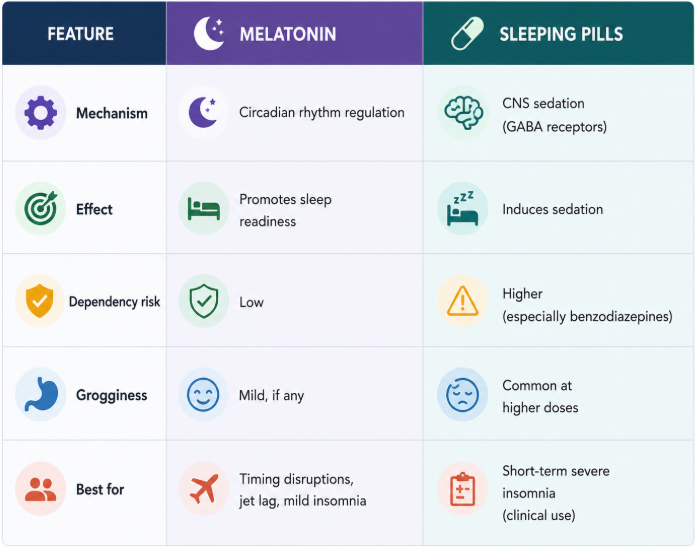
Melatonin vs Sleeping Pills: What’s the Difference?
One of the most common questions people have is which they should use: melatonin vs sleeping pills, and the distinction is significant.
The majority of over-the-counter sleep medications (such as the benzodiazepines and Z-drugs, like zolpidem) act on the GABA receptors in the brain, which have a sedative effect that essentially turns down the central nervous system activity. They can induce sleep fairly quickly. Still, they have drawbacks as well: dependency, grogginess the next day, rebound insomnia, and sleep that may be structurally different from natural sleep.
Melatonin is a completely different mechanism. It acts on the body’s own circadian receptor system (MT1 and MT2 receptors) and facilitates the action of your body’s clock, not disrupts it. It doesn’t sedate; it synchronises.
Here’s a quick comparison:
If you’re currently taking prescription sleep medication and considering melatonin, it’s worth speaking to a healthcare professional first. For more on safety considerations, our article on whether it’s safe to take melatonin every night clearly covers the research.
 |
Supporting Better Sleep
One of your body’s most basic biological signals is the melatonin hormone, which signals to your internal clock that it’s time to fall asleep. It does not cause sleepiness, but only sets up the circumstances for it.
To make the best use of melatonin, it is important to understand how it functions—timing and dosage matter. Light exposure in the hours before bed also matters. And increasingly, research suggests that protecting your natural melatonin production — by reducing screen use in the evenings and keeping a consistent sleep schedule — is just as important as any supplement.
When supplementation makes sense, Vitasunn’s range of melatonin products (1mg through to 10mg, in both standard and timed-release formats) allows you to select your preferred format.
Check out the full range, and choose the one that suits you.
Frequently Asked Questions
Q1: What exactly is melatonin?
A hormone secreted by the pineal gland, signalling darkness, and making one ready for sleep — not a sedative.
Q2: Is melatonin a sleeping pill?
No, melatonin does not work like sleeping pills, but it helps synchronise the body’s natural cycle to induce a more natural sleep.
Q3: How does melatonin make you feel?
Moderate sleepiness and decreased alertness — not full sleepiness. Ideal time of use is 30–60 min before sleep.
Q4: What is the difference between melatonin and sleeping tablets?
Sleeping medications act on the GABA receptors; melatonin acts on the circadian rhythm receptors.
Q5: Does your body stop producing melatonin if you take supplements?
Occasional supplementation doesn’t significantly suppress natural production; long-term high-dose use warrants caution.
Q6: At what age does melatonin production decline?
Natural production begins to decline around age 40, contributing to age-related sleep difficulties.
Q7: Can you take melatonin during the day?
Not recommended — it can shift circadian rhythm in the wrong direction and cause daytime grogginess.
Q8: Does light really suppress melatonin?
Yes. Blue light from screens can suppress melatonin release by up to 50%.
Contributed Dec-2022 by Alex Harpy of Sleeping Test
Melatonin is a hormone that is produced naturally in the body and is involved in the regulation of sleep. It is often called the “sleep hormone” because its levels increase in the body at night, signaling to the body that it is time to sleep.
Melatonin is available over-the-counter as a dietary supplement in the United States, but it is important to speak with a doctor before using it. The proper dosage of melatonin can vary depending on a person’s age, weight, and other factors, and a doctor can help determine the right amount for an individual. If you live in Europe, Vitasunn can dispatch and deliver melatonin within the EU where it is difficult to find. Melatonin is commonly prescribed for sleep disorders where both quantity and quality of sleep are affected.
Common sleep disorders
Insomnia: Insomnia is the most common sleep disorder and is characterized by difficulty falling or staying asleep, or waking up feeling unrefreshed. Insomnia can be caused by a variety of factors, including stress, anxiety, depression, and certain medications.
Sleep apnea: Sleep apnea is a condition in which a person's breathing is repeatedly interrupted during sleep, causing them to wake up frequently throughout the night. This can lead to excessive daytime sleepiness and other health problems.
Narcolepsy: Narcolepsy is a neurological disorder that affects the control of sleep and wakefulness. People with narcolepsy experience excessive daytime sleepiness and may have sudden, irresistible episodes of sleep during the day.
Treatment for sleep disorders varies depending on the type and severity of the disorder. It may include lifestyle changes, such as improving sleep hygiene, or the use of medications or other therapies. It is important to talk to a healthcare provider for an accurate diagnosis and appropriate treatment.
Melatonin supplements
Melatonin supplements come in a variety of forms, including tablets, capsules, and liquids. Some common types of melatonin supplements include:
Immediate-release melatonin: This type of melatonin supplement is designed to be quickly absorbed into the body, allowing for rapid onset of effects. It is often used for the treatment of jet lag or to help with falling asleep.
Extended-release melatonin: This type of melatonin supplement is designed to be released gradually over a longer period of time, allowing for more sustained effects. It is often used for the treatment of insomnia and other chronic sleep disorders.
Melatonin with added ingredients: Some melatonin supplements include additional ingredients, such as herbs or other compounds, that may help with sleep or relaxation. For example, some melatonin supplements may contain valerian root or GABA (gamma-aminobutyric acid) to enhance their effects.
It is important to note that the effectiveness and safety of melatonin supplements can vary depending on the type and quality of the product. It is always best to talk to a healthcare provider before using any supplement, including melatonin.
Can melatonin supplements help with sleep apnea?
There is evidence to suggest that melatonin may be effective in treating sleep apnea. In a study conducted by the University of California, San Diego, researchers found that melatonin improved sleep efficiency, reduced the number of awakenings, and increased the amount of time spent in deep sleep in patients with sleep apnea.
Another study published in the Journal of Clinical Medicine supports evidence about the moderate efficacy of melatonin and a melatonin receptor agonist (ramelteon) in increasing total sleep time and reducing sleep latency. The researchers also found that melatonin had a positive effect on the nervous system, which is involved in the regulation of breathing during sleep.
In addition to its potential benefits for sleep apnea, melatonin has also been shown to have other positive effects on sleep. It can help to reduce the time it takes to fall asleep, improve sleep quality, and reduce the symptoms of jet lag.
Other treatments for sleep apnea
While melatonin may be effective in treating sleep apnea, it is not a cure-all. In some cases, other treatments such as continuous positive airway pressure (CPAP), which delivers air through a mask to keep the airway open during sleep. Other treatments may include weight loss, lifestyle changes, and surgery to remove excess tissue from the airway.
Weight loss can also be an effective treatment for sleep apnea, as excess weight can contribute to the obstruction of the airway. Losing weight can help to reduce the severity of sleep apnea and improve sleep quality.
Lifestyle changes, such as avoiding alcohol and sleeping on your side, can also help to alleviate symptoms of sleep apnea. Avoiding alcohol, in particular, can be beneficial because it can relax the muscles in the throat.
In some cases, surgery may be necessary to treat sleep apnea. Procedures such as uvulopalatopharyngoplasty (UPPP) and laser-assisted uvulopalatoplasty (LAUP) can help to remove excess tissue from the airway and improve breathing during sleep.
It is important to see a doctor for a proper diagnosis and treatment plan for sleep apnea. Untreated sleep apnea can lead to serious health problems and a decreased quality of life. Prioritizing good sleep is important for overall health and well-being.